

Aerosol and Ocean Color Product Validation: FastMAPOL Algorithm on SPEXone Instrument
This page summarizes the validation of aerosol and ocean products retrieved from the PACE multi-angle polarimeters using FastMAPOL algorithm. The algorithm performs coupled aerosol-surface retrievals for both HARP2 and SPEXone; here we focus on validation of SPEXone aerosol optical properties and ocean remote-sensing reflectance (Rrs) on NASA EarthData.
FastMAPOL retrieves aerosol and ocean properties using an optimal-estimation framework accelerated with deep neural network forward models (Gao et al., 2021; Gao et al., 2023), based on a coupled atmosphere-ocean vector radiative transfer model (Zhai et al., 2022). Detailed validation methodology and results are summarized in (Gao et al., 2026).
Retrieval Products
Aerosol- Total, fine-mode, and coarse-mode aerosol optical depth (AOD)
- Total, fine-mode, and coarse-mode single-scattering albedo (SSA)
- Fine- and coarse-mode effective radius and variance
- Fine- and coarse-mode complex refractive index
- Fine- and coarse-mode spherical fraction
- Aerosol layer height
- Ocean remote-sensing reflectance (Rrs)
- Chlorophyll-α (Chl-α)
- Surface wind speed
Validation Approach
Performance is assessed in three stages:- Global Level-3 assessment – Evaluate large-scale spatial patterns and variability of aerosol and ocean products and examine aerosol-ocean decoupling.
- Global aerosol validation – Compare aerosol retrievals with AERONET observations to quantify aerosol uncertainty, providing a foundation for assessing atmospheric correction performance.
- Joint aerosol-ocean validation – Use AERONET-OC matchups to evaluate aerosol and Rrs simultaneously under shared viewing geometry and environmental conditions.
1. Global Level-3 Products
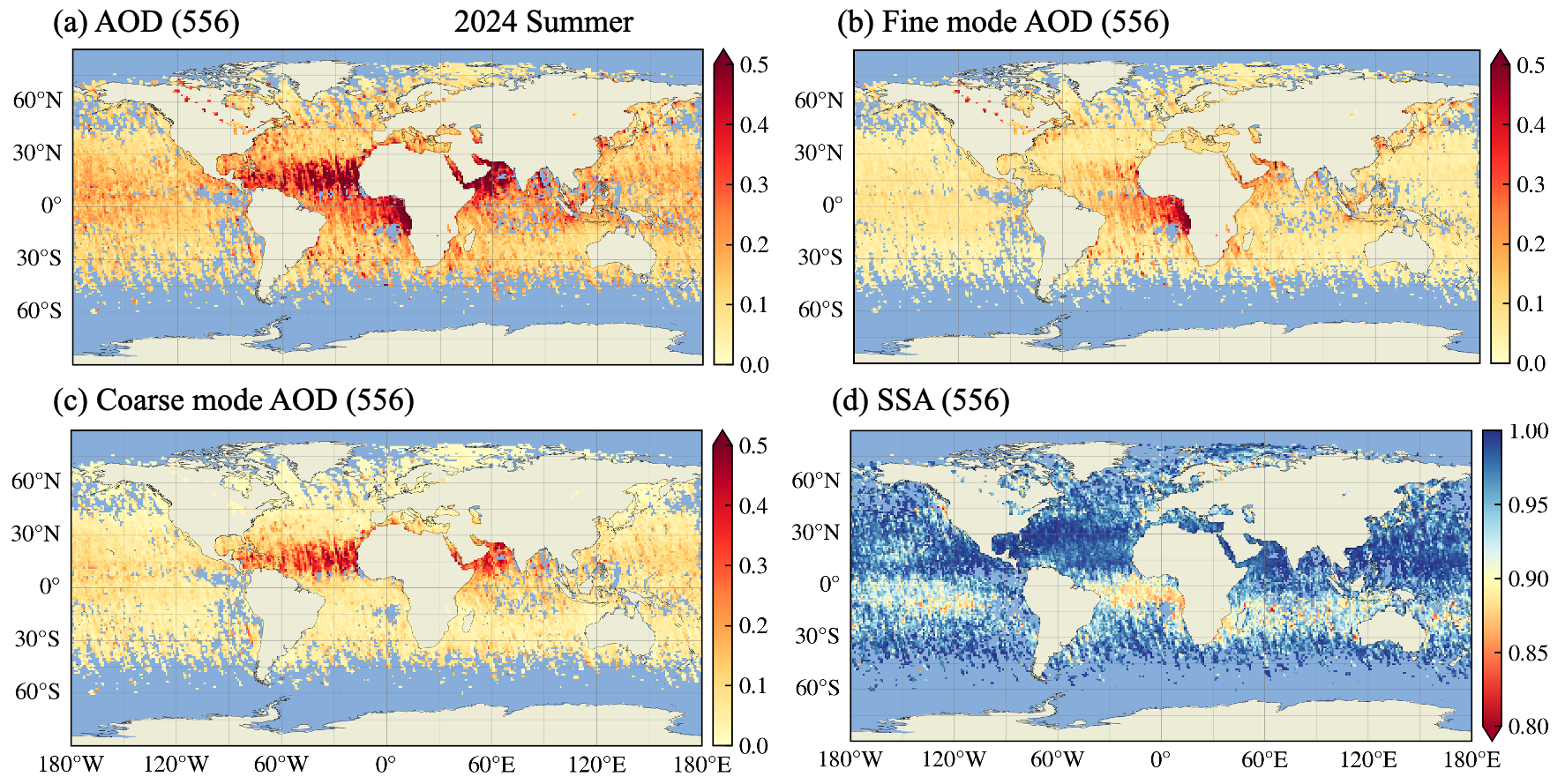
Level-3 gridded data can be accessed through OB.DAAC on NASA Earthdata Cloud: https://doi.org/10.5067/PACE/SPEXone/L3M/MAPOL_OCEAN/3.0Aerosol (556 nm) Global distributions of total, fine, and coarse AOD and SSA at 556 nm:
 Ocean Products
Global distributions of Rrs (443, 556, 667 nm) and Chl-α:
Ocean Products
Global distributions of Rrs (443, 556, 667 nm) and Chl-α:
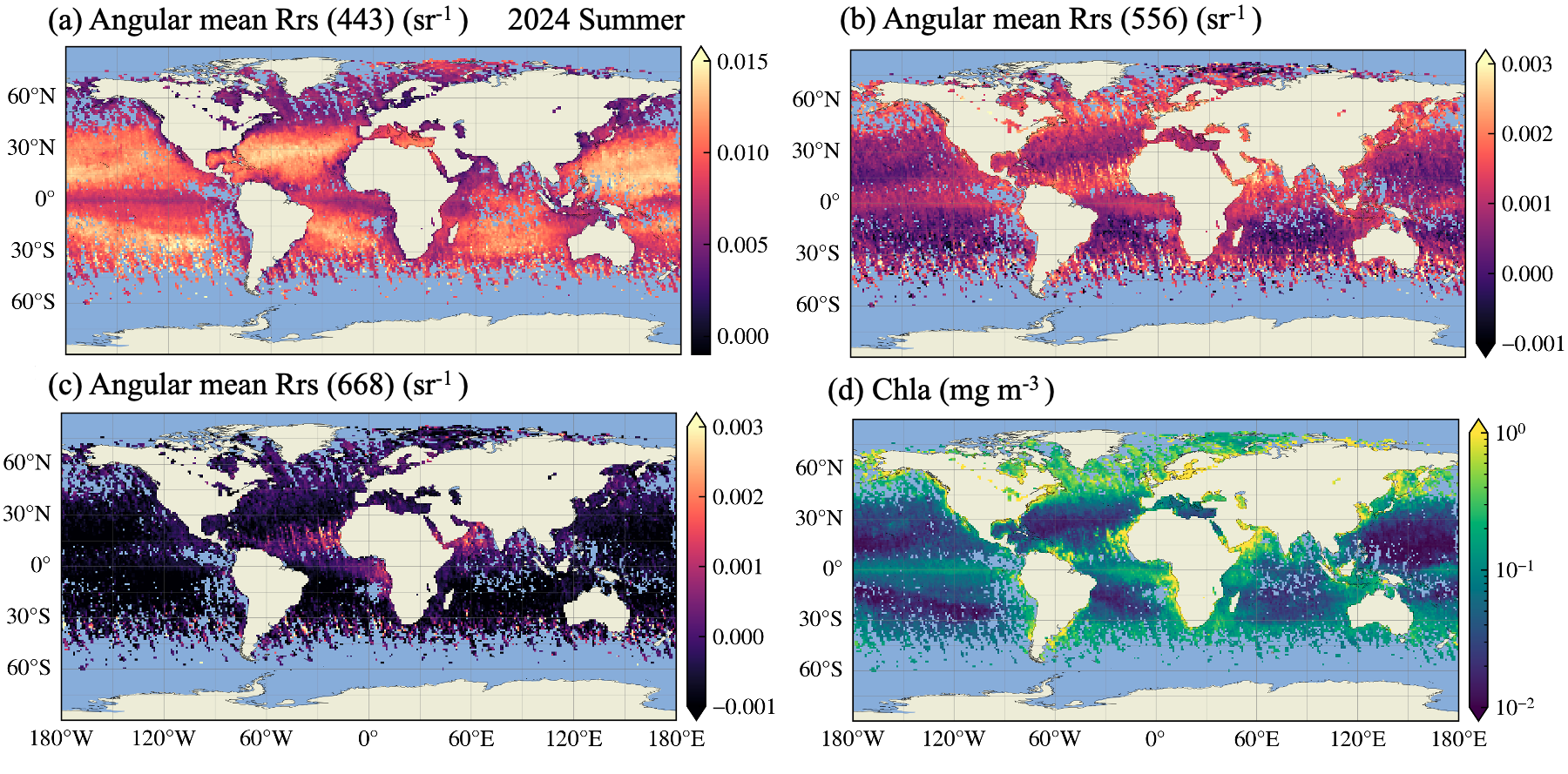
The retrieved Rrs contains spectral and angular dimensions. The results shown here represents the BRDF-corrected angular mean.
The global analysis demonstrates that aerosol and ocean products exhibit realistic spatial and seasonal patterns, with clear separation of atmospheric and oceanic retrieval components. The global analysis demonstrates that aerosol and ocean products exhibit realistic spatial and seasonal patterns, with clear separation of atmospheric and oceanic retrieval components.
2. Global Aerosol Validation
The aerosol retrievals are validated against AERONET measurements. Aerosol level-2 data can be accessed here: https://doi.org/10.5067/PACE/SPEXone/L2/MAPOL_OCEAN/3.0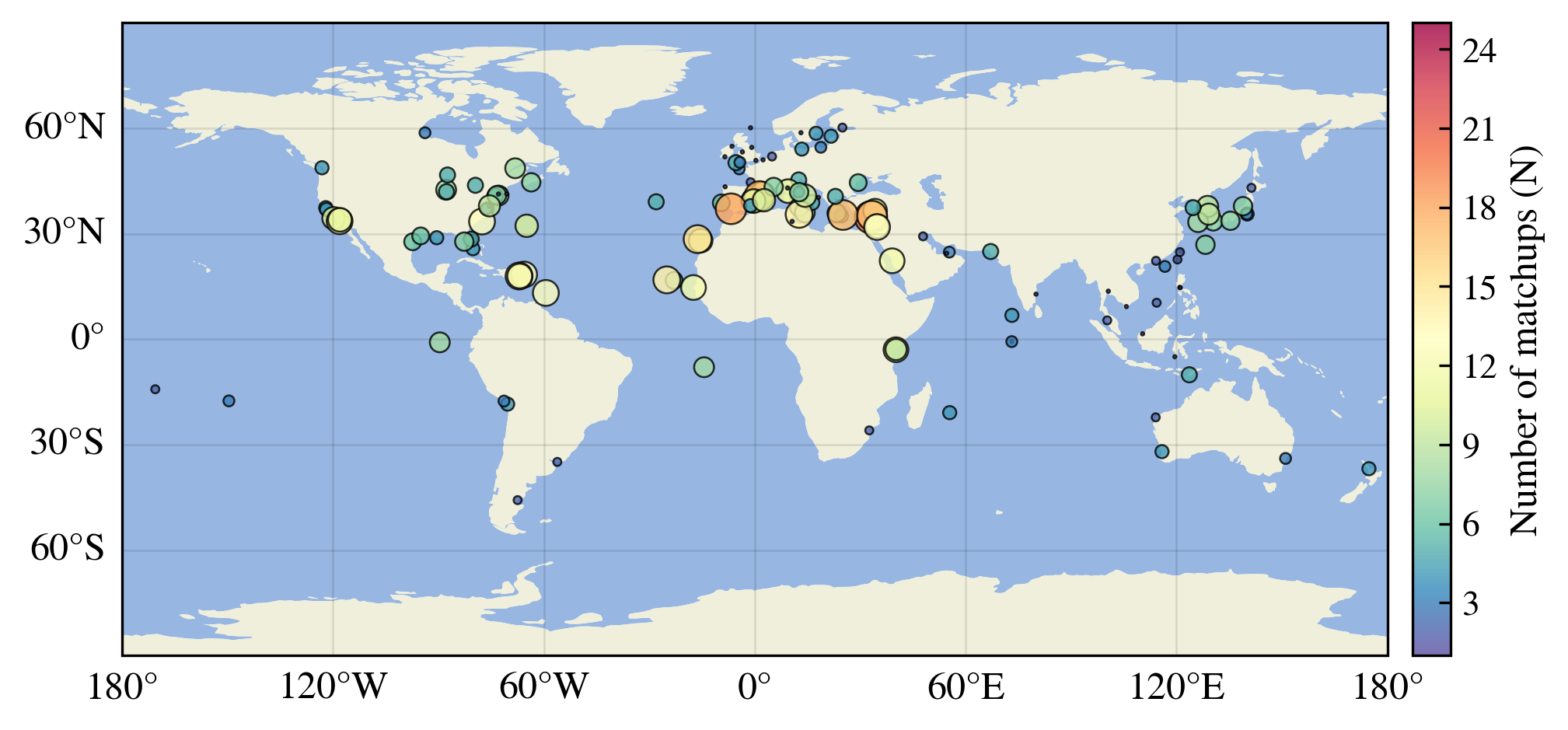
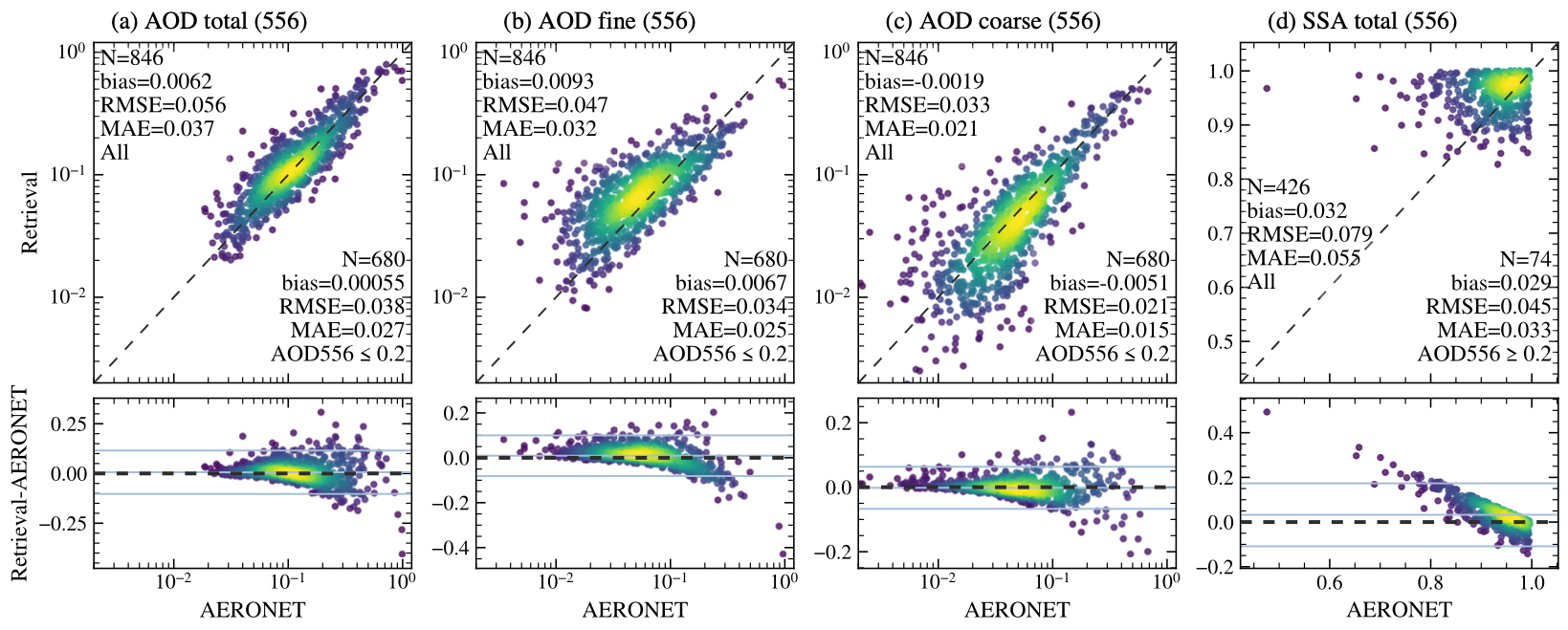
AOD and SSA Comparison (556 nm)
 Spectral Performance (410-750 nm)
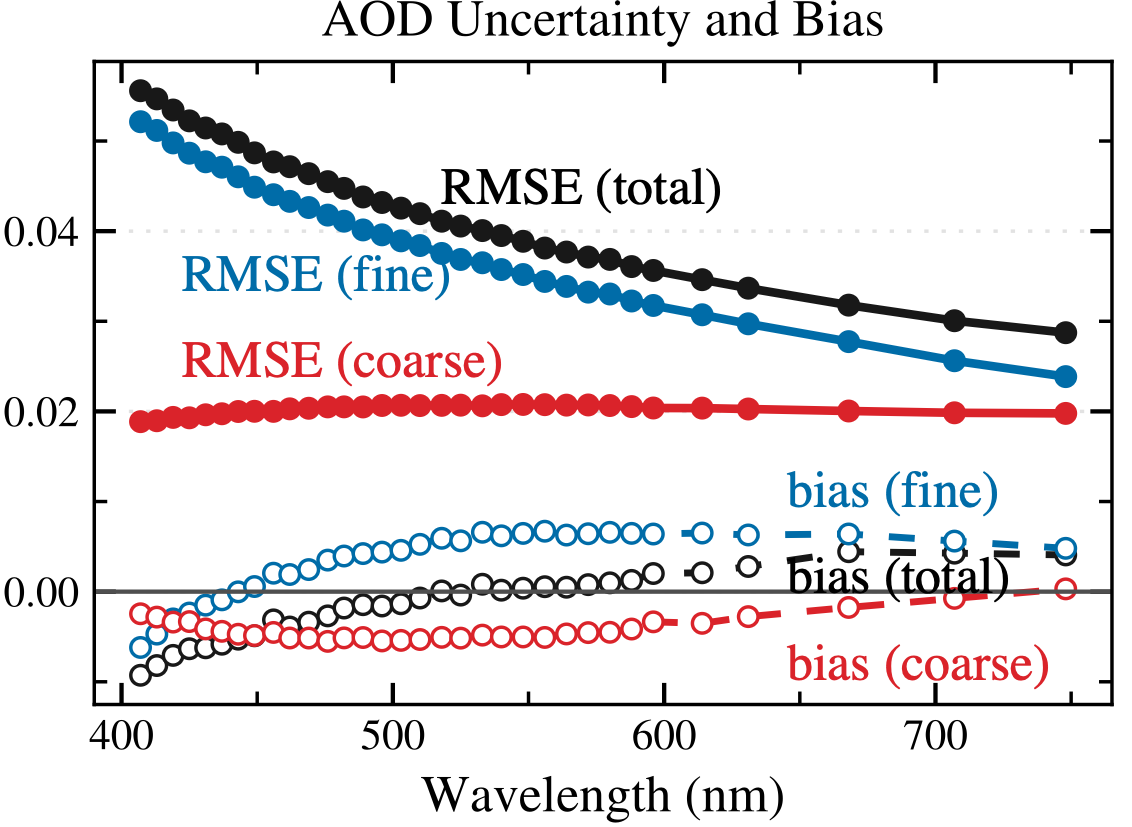 Comparison with AERONET observations confirms that aerosol retrievals achieve high performance, with small biases and well-characterized uncertainties across a broad range of AOD.
Comparison with AERONET observations confirms that aerosol retrievals achieve high performance, with small biases and well-characterized uncertainties across a broad range of AOD.
Comparison with AERONET observations confirms that aerosol retrievals achieve high performance, with small biases and well-characterized uncertainties across a broad range of AOD.
3. Joint Aerosol-Ocean Validation
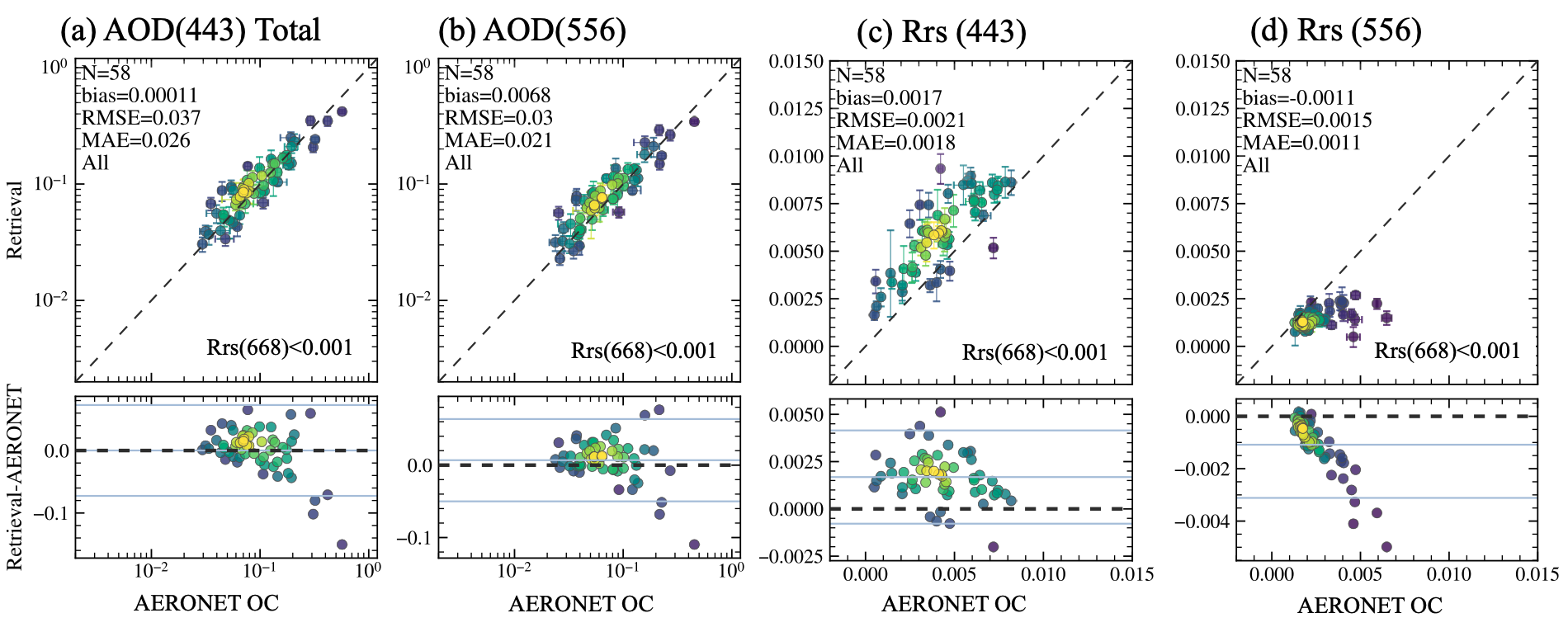
AERONET-OC sites are used for simultaneous aerosol and Rrs validation. Ocean color level-2 data can be accessed in the same file as the aerosol products.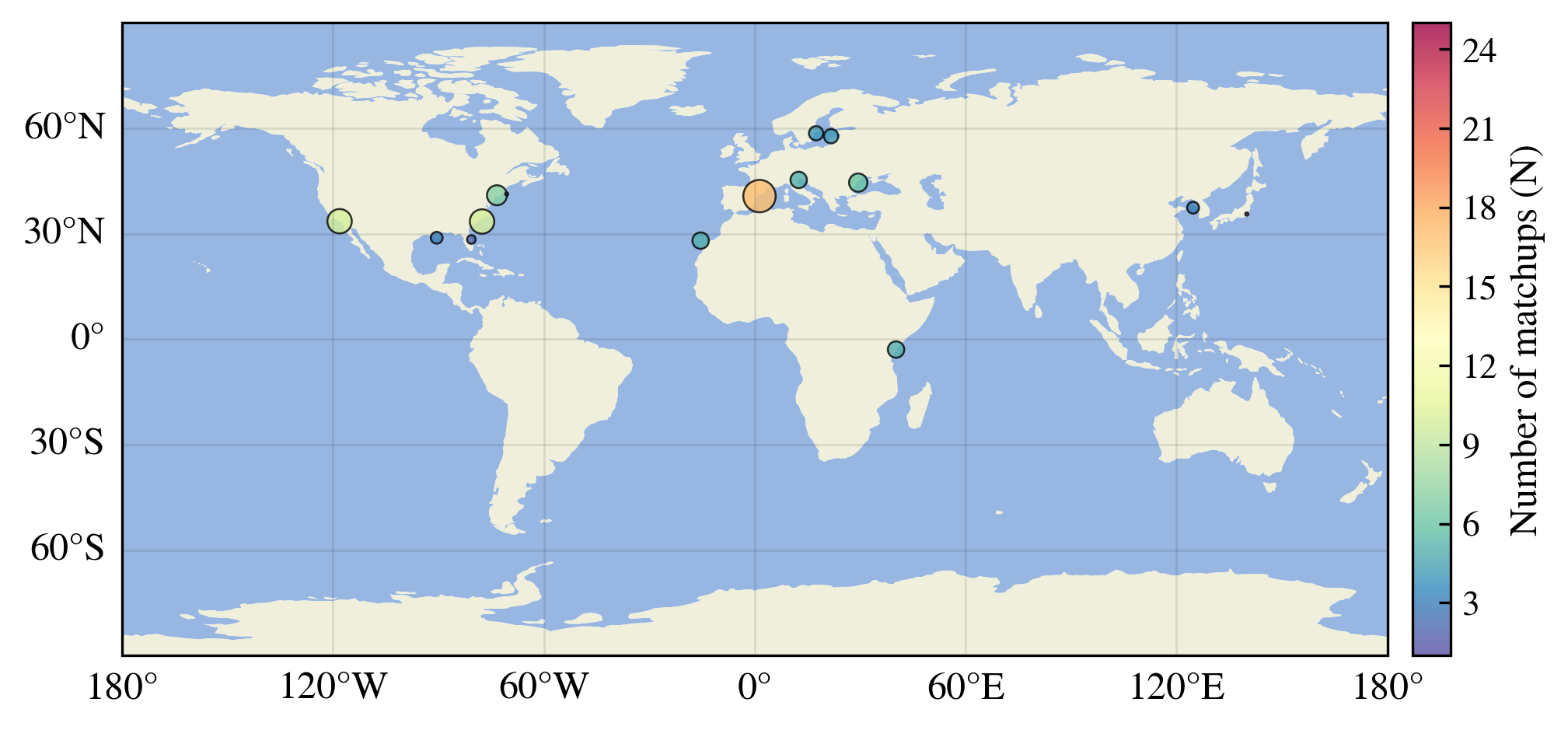 AOD and Rrs Comparison (443 and 556 nm)
 Spectral Rrs Comparison
Mean spectra are shown in the upper panel (mean ± standard deviation) and differences are shown in the lower panel (bias ± RMSE):
Spectral Rrs Comparison
Mean spectra are shown in the upper panel (mean ± standard deviation) and differences are shown in the lower panel (bias ± RMSE):
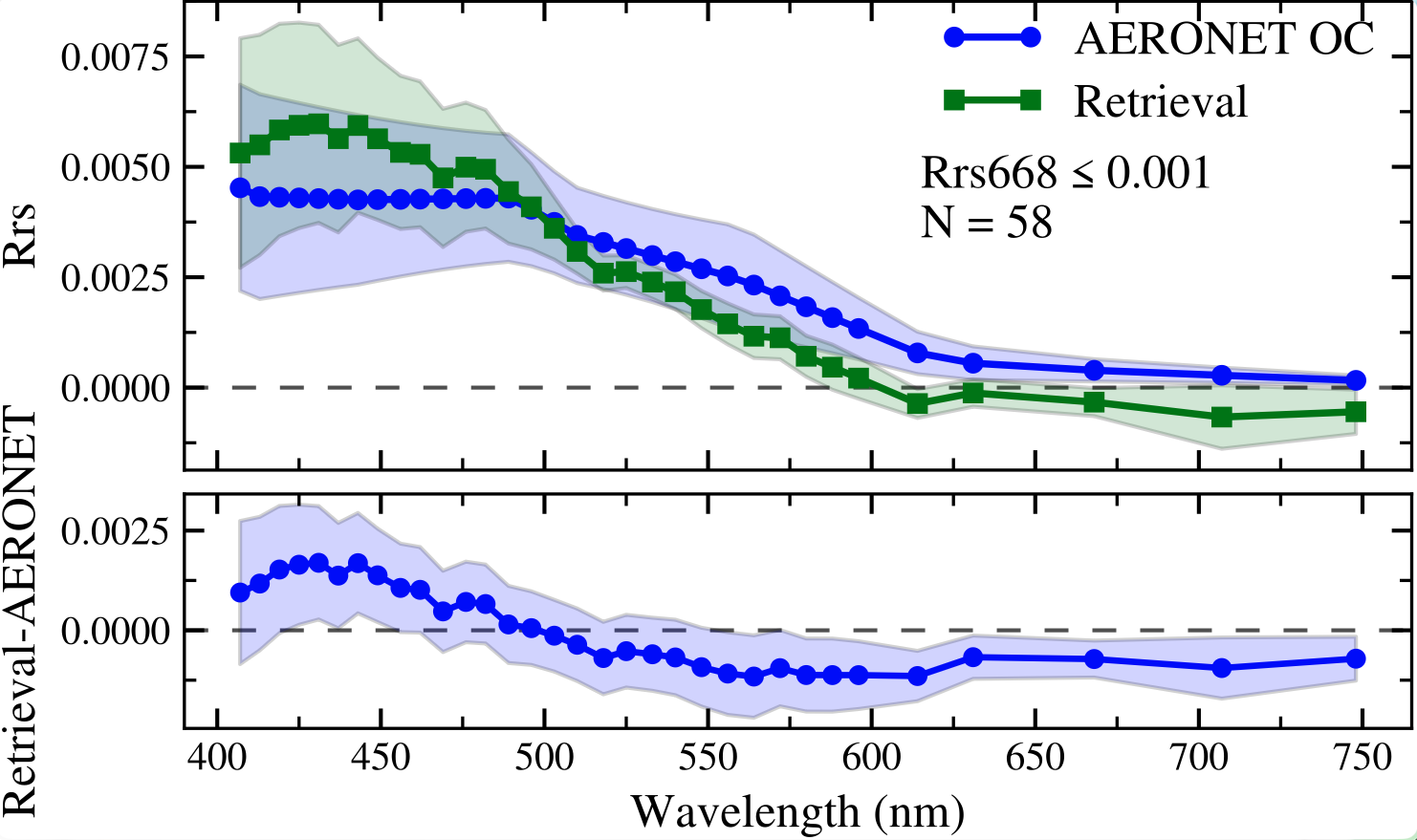 Simultaneous evaluation against AERONET-OC shows that aerosol and Rrs retrievals remain mutually consistent, supporting robust atmospheric correction and reliable ocean color products under mixed water condition.
Simultaneous evaluation against AERONET-OC shows that aerosol and Rrs retrievals remain mutually consistent, supporting robust atmospheric correction and reliable ocean color products under mixed water condition.
Simultaneous evaluation against AERONET-OC shows that aerosol and Rrs retrievals remain mutually consistent, supporting robust atmospheric correction and reliable ocean color products under mixed water condition.